
Learn how to study computer science effectively with proven strategies, coding practice tips, learning resources, and exam preparation techniques. Improve your programming skills and academic performance today.
Computer Science is one of the most exciting and rapidly growing fields in the modern world. From software development and artificial intelligence to cybersecurity and data science, computer science opens doors to countless career opportunities. However, many students struggle to understand programming concepts, algorithms, and technical subjects effectively.
The good news is that success in computer science does not depend solely on intelligence. Instead, it requires the right study techniques, consistent practice, and a structured learning approach. In this guide, you will learn practical strategies to study computer science effectively, improve your coding skills, and achieve academic success.
Understand the Fundamentals First
Before diving into advanced topics, it is essential to build a strong foundation. Many students rush into learning complex programming languages and frameworks without understanding the basics.
Focus on fundamental concepts such as:
Programming Logic
Programming logic is the ability to think step-by-step and solve problems systematically. Understanding conditions, loops, variables, and functions is crucial.
Data Structures
Learn about arrays, linked lists, stacks, queues, trees, and graphs. These concepts form the backbone of efficient programming.
Algorithms
Study basic algorithms such as sorting, searching, and recursion. Algorithms help you understand how computers solve problems efficiently.
Computer Architecture
Understanding how computers work internally helps you write better code and troubleshoot technical issues.
A strong foundation makes advanced concepts much easier to learn later.
Create a Structured Study Plan
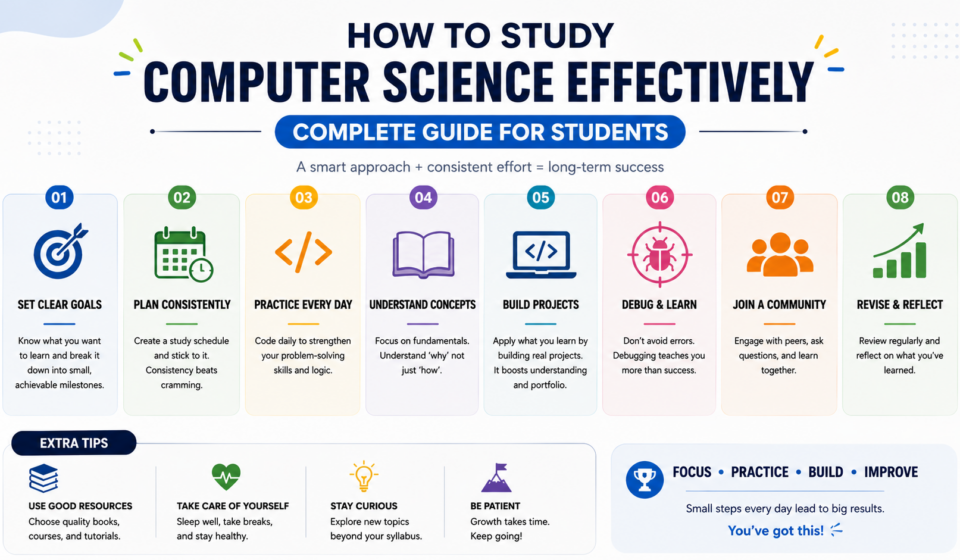
One of the biggest mistakes students make is studying randomly. A structured study plan ensures consistent progress.
Create a weekly schedule that includes:
Theory Learning
Spend time understanding concepts through textbooks, lectures, and tutorials.
Coding Practice
Dedicate at least one hour daily to coding exercises.
Revision Sessions
Review previously learned topics regularly to improve retention.
Project Development
Work on practical projects to apply your knowledge in real-world scenarios.
Consistency is more important than studying for long hours occasionally.
Learn by Coding Every Day
Computer science is a practical subject. Reading about programming is not enough. The best way to learn is by writing code consistently.
Benefits of daily coding practice include:
- Improved problem-solving skills
- Better understanding of syntax
- Faster debugging abilities
- Increased coding confidence
Start with simple exercises and gradually move toward complex projects.
Popular platforms for coding practice include:
- LeetCode
- HackerRank
- Codewars
- GeeksforGeeks
- CodeChef
Even 30 minutes of daily coding can significantly improve your skills over time.
Focus on Problem-Solving Skills
Programming is fundamentally about solving problems. Instead of memorizing code, focus on understanding the logic behind solutions.
Break Problems into Smaller Parts
Large problems often seem overwhelming. Divide them into smaller tasks that are easier to solve.
Practice Logical Thinking
Try solving puzzles, logic challenges, and algorithm problems regularly.
Analyze Multiple Solutions
Study how different programmers solve the same problem. This broadens your understanding and improves creativity.
Strong problem-solving skills are often more valuable than knowledge of a specific programming language.
Use High-Quality Learning Resources
Choosing the right resources can accelerate your learning journey.
Books
Books provide detailed explanations and structured learning paths.
Recommended books include:
- Clean Code by Robert C. Martin
- Introduction to Algorithms
- Computer Science Distilled
- The Pragmatic Programmer
Online Courses
Video-based courses help simplify difficult concepts.
Popular platforms include:
- Coursera
- Udemy
- edX
- freeCodeCamp
Documentation
Official documentation is one of the most reliable learning resources. Learning how to read documentation is an essential skill for every developer.
Build Real-World Projects
Projects help transform theoretical knowledge into practical experience.
Some beginner-friendly project ideas include:
Calculator Application
Learn basic programming concepts and user interaction.
To-Do List App
Practice data storage and application logic.
Weather Application
Understand APIs and data fetching.
Portfolio Website
Develop web development skills and showcase your work.
Expense Tracker
Learn database integration and backend development.
Projects also strengthen your resume and portfolio.
Master Data Structures and Algorithms
Data Structures and Algorithms (DSA) play a critical role in computer science education and technical interviews.
Important topics include:
Arrays and Strings
The foundation of most programming problems.
Linked Lists
Help understand dynamic memory concepts.
Stacks and Queues
Commonly used in system design and applications.
Trees and Graphs
Essential for advanced problem-solving.
Sorting and Searching Algorithms
Improve computational efficiency.
Regular DSA practice improves coding interviews and competitive programming performance.
Take Effective Notes
Good notes can significantly improve understanding and retention.
Write Concepts in Your Own Words
Avoid copying directly from textbooks.
Include Code Examples
Practical examples make concepts easier to remember.
Use Diagrams
Flowcharts and visual representations simplify complex topics.
Create Quick Revision Sheets
Summarize important concepts for exam preparation.
Effective notes save time during revision periods.
Join Computer Science Communities
Learning with others can boost motivation and accelerate growth.
Participate in:
Programming Forums
Communities such as Stack Overflow help solve coding challenges.
Developer Groups
Join local and online programming groups.
Open Source Projects
Contributing to open-source software provides real-world experience.
Coding Competitions
Competitions improve speed, accuracy, and confidence.
Collaboration exposes you to new perspectives and learning opportunities.
Prepare Smartly for Computer Science Exams
Exam preparation requires a different approach from regular learning.
Review Core Concepts
Focus on frequently tested topics.
Practice Previous Papers
Understand question patterns and exam formats.
Solve Sample Problems
Apply concepts under time constraints.
Revise Frequently
Short revision sessions are more effective than last-minute cramming.
A balanced combination of theory and practical problem-solving leads to better exam performance.
Avoid Common Mistakes
Many students struggle because they repeat common learning mistakes.
Avoid these habits:
- Memorizing code without understanding logic
- Skipping foundational concepts
- Ignoring debugging practice
- Learning too many programming languages at once
- Avoiding hands-on projects
- Studying inconsistently
Recognizing these mistakes early can save significant time and frustration.
Stay Updated with Technology Trends
Technology evolves rapidly. Continuous learning is essential for long-term success.
Follow developments in:
Artificial Intelligence
AI is transforming multiple industries.
Cybersecurity
Security skills are increasingly valuable.
Cloud Computing
Cloud technologies power modern applications.
Data Science
Data-driven decision-making is growing across industries.
Software Development
Stay informed about new frameworks and tools.
Reading technology blogs and industry news helps maintain relevance.
Develop a Growth Mindset
Computer science can be challenging, especially when learning programming for the first time. Many successful developers faced numerous failures before achieving expertise.
Remember these principles:
- Mistakes are part of learning.
- Debugging improves problem-solving skills.
- Consistency beats intensity.
- Every expert was once a beginner.
Maintaining a positive mindset can significantly improve learning outcomes.
Sources
https://l1nq.com/ikt4c98
https://sl1nk.com/jdhl0vv
Conclusion
Learning computer science effectively requires a combination of strong fundamentals, daily coding practice, problem-solving skills, and consistent effort. Rather than focusing on memorization, prioritize understanding concepts and applying them through projects and coding exercises.
By following a structured study plan, practicing regularly, mastering data structures and algorithms, and staying updated with industry trends, you can build a successful career in computer science. The journey may be challenging, but with persistence and the right approach, anyone can become proficient in this exciting field.
FAQs
What is the best way to study computer science effectively?
The best approach is to combine theoretical learning with daily coding practice, project development, and regular revision of core concepts.
How many hours should I study computer science daily?
Most students benefit from studying computer science for 2–4 focused hours per day, including coding practice and concept review.
Is coding necessary for learning computer science?
Yes, coding is an essential part of computer science because it helps apply theoretical concepts and improve problem-solving abilities.
Which programming language should beginners learn first?
Python is often recommended for beginners because of its simple syntax and wide range of applications.
How can I improve my problem-solving skills in computer science?
Regularly solving coding challenges, practicing algorithms, and breaking complex problems into smaller steps can significantly improve problem-solving skills.