
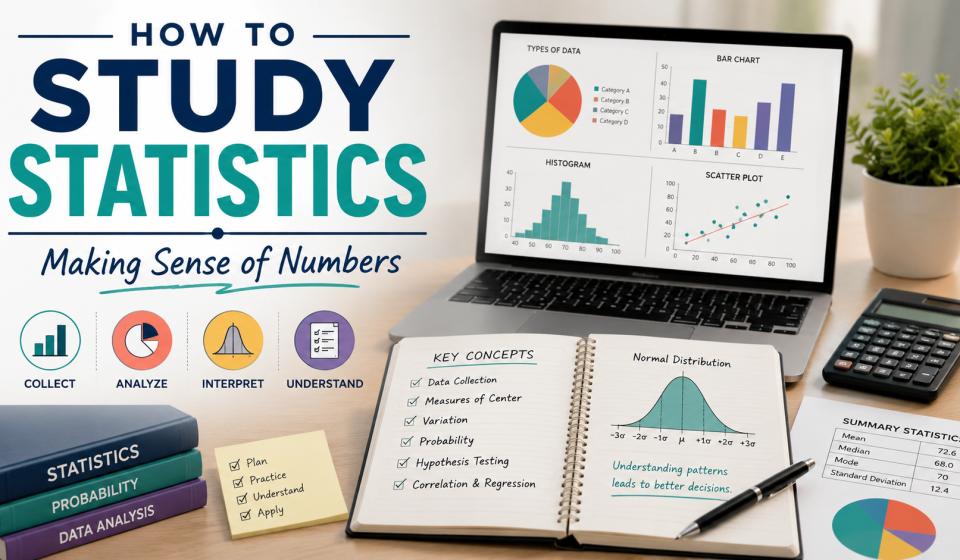

Learn how to study statistics effectively with simple strategies, practical examples, and proven techniques. Discover how to understand data, formulas, probability, and statistical concepts with confidence.
Statistics is often considered one of the most challenging subjects because it involves numbers, formulas, graphs, and data interpretation. However, statistics is not just about calculations—it is about understanding what numbers mean and how they help us make better decisions.
From business and healthcare to technology and education, statistics plays an important role in analyzing information and identifying patterns. Whether you are a school student, college learner, or professional preparing for exams, learning statistics can become much easier when you approach it with the right strategy.
This guide will help you understand how to study statistics effectively and make sense of numbers without feeling overwhelmed.
Understand What Statistics Really Means
Many students focus only on memorizing formulas. While formulas are important, statistics is mainly about understanding data and drawing meaningful conclusions.
Statistics helps answer questions such as:
- What is the average performance of a class?
- How likely is an event to happen?
- What trends can be observed in sales data?
- How can data help make informed decisions?
Before diving into calculations, try to understand the purpose behind each concept. When you know why a statistical method is used, it becomes easier to remember and apply.
Build a Strong Foundation in Basic Mathematics
Statistics relies on basic mathematical skills. Before studying advanced topics, make sure you are comfortable with:
- Addition, subtraction, multiplication, and division
- Fractions and percentages
- Ratios and proportions
- Basic algebra
- Graph reading and interpretation
A strong mathematical foundation reduces confusion and helps you solve statistical problems more efficiently.
Learn Statistical Terms One Step at a Time
Statistics introduces many new terms that can feel intimidating at first.
Some important concepts include:
- Population
- Sample
- Variable
- Mean
- Median
- Mode
- Range
- Standard Deviation
- Probability
- Correlation
Instead of trying to learn everything at once, focus on one concept at a time. Create simple definitions in your own words and relate them to real-life situations.
For example, if a teacher calculates the average score of students in a class, that average is known as the mean.
Using everyday examples helps make concepts easier to understand.
Focus on Understanding Rather Than Memorization
One of the biggest mistakes students make is memorizing formulas without understanding their purpose.
Ask yourself:
- What does this formula measure?
- Why is it useful?
- When should it be used?
For example, the mean helps identify the average value in a dataset.
xˉ=n∑x
Instead of memorizing the formula alone, understand that it represents the average of all observations.
When concepts make sense logically, formulas become easier to remember.
Practice with Real Data
Statistics becomes much more interesting when you use real-world information.
You can analyze:
- Sports scores
- Weather data
- Social media trends
- Business sales figures
- Survey responses
Working with real datasets helps you understand how statistics is used in everyday life.
For example, calculate:
- Average monthly expenses
- Average exam scores
- Most common customer preferences
Practical learning improves retention and confidence.
Master Data Visualization Skills
Graphs and charts are essential in statistics because they transform complex data into easy-to-understand visuals.
Learn how to interpret:
- Bar graphs
- Pie charts
- Histograms
- Line graphs
- Scatter plots
Understanding visual data can help you identify trends, patterns, and relationships quickly.
When studying graphs, ask:
- What trend is visible?
- Is the data increasing or decreasing?
- Are there any unusual observations?
These questions improve analytical thinking.
Understand Probability Before Advanced Statistics
Probability forms the foundation of many statistical concepts.
Probability helps determine how likely an event is to occur.
Examples include:
- Tossing a coin
- Rolling a dice
- Predicting weather conditions
- Risk assessment in business
A solid understanding of probability makes topics such as hypothesis testing and inferential statistics easier to learn.
Start with simple examples before moving to complex probability calculations.
Create a Formula Sheet
Statistics includes multiple formulas, which can sometimes feel overwhelming.
Maintain a dedicated formula sheet containing:
- Mean formula
- Median calculations
- Variance formulas
- Standard deviation formulas
- Probability equations
Organize formulas by topic and include short notes explaining their purpose.
Review the sheet regularly to strengthen memory and improve exam preparation.
Solve Problems Every Day
Statistics is a skill-based subject.
Reading theory alone is not enough.
Try solving:
- Practice exercises
- Sample papers
- Previous exam questions
- Online quizzes
Even 20 to 30 minutes of daily practice can significantly improve understanding.
As you solve more problems, patterns become easier to recognize and calculations become faster.
Learn How to Interpret Results
Many students can perform calculations but struggle to explain their meaning.
Statistics is valuable because of interpretation.
For example:
If the average test score is 85, what does that tell us?
It suggests that most students performed well.
Whenever you complete a calculation, ask:
- What does this result indicate?
- How can it help decision-making?
- What conclusions can be drawn?
Interpretation skills are highly valued in academics and professional environments.
Use Technology to Support Learning
Modern tools can make statistics easier and more engaging.
Useful tools include:
- Microsoft Excel
- Google Sheets
- Calculator applications
- Statistical software
- Online learning platforms
These tools help visualize data, perform calculations, and understand concepts more efficiently.
Technology should support learning, not replace understanding.
Always learn the underlying concepts first.
Study Statistics with Active Learning Techniques
Active learning helps improve retention and understanding.
Effective techniques include:
Teaching Someone Else
Explaining concepts to a friend helps identify knowledge gaps and strengthens understanding.
Creating Summary Notes
Write key ideas in simple language after each study session.
Using Flashcards
Flashcards are useful for remembering formulas, definitions, and concepts.
Practicing Concept Mapping
Create diagrams connecting statistical topics and formulas.
These methods encourage deeper learning and improve long-term memory.
Avoid Common Mistakes When Studying Statistics
Many students struggle because they:
- Memorize formulas without understanding
- Skip basic concepts
- Avoid practice questions
- Ignore data interpretation
- Study only before exams
To succeed:
- Build strong fundamentals
- Practice consistently
- Focus on understanding
- Use real-life examples
- Review concepts regularly
Small improvements over time lead to significant progress.
Develop a Statistics Study Schedule
A structured study plan improves consistency.
A sample weekly schedule:
Monday
Review basic concepts and formulas.
Tuesday
Practice mean, median, and mode questions.
Wednesday
Study probability concepts.
Thursday
Interpret graphs and charts.
Friday
Solve mixed practice problems.
Saturday
Review difficult topics.
Sunday
Take a mini test and analyze mistakes.
A balanced schedule prevents last-minute stress and improves retention.
Build Confidence Through Consistent Practice
Statistics may seem difficult initially, but confidence grows with regular effort.
Remember:
- Every expert started as a beginner.
- Mistakes are part of learning.
- Practice develops understanding.
- Concepts become easier with repetition.
Instead of fearing numbers, focus on understanding the story behind the data.
When you approach statistics as a tool for solving real-world problems, the subject becomes much more interesting and meaningful.
Sources
https://l1nq.com/zt2neg3
https://l1nq.com/atf1tvx
Conclusion
Statistics is much more than formulas and calculations. It is a powerful tool that helps us understand information, identify trends, and make informed decisions. By building strong fundamentals, practicing regularly, understanding concepts rather than memorizing formulas, and working with real-world data, students can learn statistics effectively and confidently.
The key to success in statistics is consistency. With patience, practice, and the right study techniques, anyone can develop the skills needed to analyze data and make sense of numbers. Over time, statistics can become one of the most useful and rewarding subjects to learn.
FAQs
What is the best way to study statistics?
The best way to study statistics is to understand concepts first, practice problems regularly, and use real-world examples to connect theory with practical applications.
Why do students find statistics difficult?
Many students find statistics challenging because they focus on memorizing formulas instead of understanding the concepts behind them.
How much time should I spend studying statistics daily?
Studying statistics for 20–30 minutes daily can help improve understanding and retention significantly.
Do I need strong math skills to learn statistics?
Basic mathematical skills are helpful, but advanced mathematics is not always necessary for learning fundamental statistical concepts.
How can I improve my statistics problem-solving skills?
Practice regularly, review mistakes, solve previous exam questions, and learn how to interpret results effectively.