
Learn how to create effective study summaries that improve memory, understanding, and exam performance. Discover practical note-taking methods, summary techniques, and mistakes to avoid for smarter studying.
Studying for exams can feel overwhelming when textbooks, lectures, and online resources pile up. Many students spend hours rereading notes without actually remembering important concepts. That is where smart summaries become powerful. A well-made study summary helps you understand information faster, remember key points longer, and revise more efficiently before exams.
However, not all summaries are useful. Some students simply copy paragraphs from books, which does not improve learning. Effective summaries are short, organized, and focused on understanding rather than memorization alone.
In this guide, you will learn how to create summaries that truly help you study better. From choosing the right format to avoiding common mistakes, this article covers practical strategies that students can use for school, college, competitive exams, and self-learning.
Why Study Summaries Matter
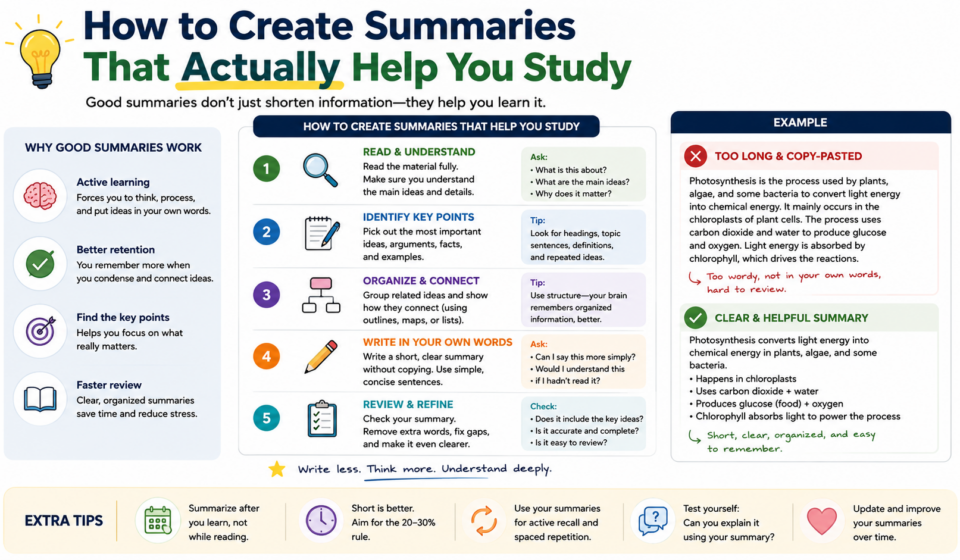
Good summaries save time and improve retention. Instead of reviewing entire chapters repeatedly, students can revise condensed information quickly. Summaries also help break complicated topics into smaller, understandable sections.
Benefits of effective summaries include:
- Faster revision before exams
- Better memory retention
- Improved understanding of concepts
- Reduced study stress
- Easier organization of subjects
- Better focus during learning sessions
Research in cognitive psychology shows that actively processing information improves long-term memory. Writing summaries forces your brain to analyze and simplify concepts, which strengthens learning.
Understand Before You Summarize
One of the biggest mistakes students make is summarizing without understanding the topic first. If you do not understand the material, your summary will become a copied version of the textbook.
Before writing a summary:
- Read the topic carefully
- Highlight key ideas
- Identify definitions, formulas, and important facts
- Ask yourself what the main concept is
- Explain the topic mentally in simple words
If you can explain a concept simply, you truly understand it.
Choose the Right Summary Style
Different subjects require different summary techniques. Choosing the right format can make studying easier and more effective.
Bullet Point Summaries
Bullet points work best for factual subjects like history, biology, and geography. They keep information organized and easy to scan quickly.
Example:
- Photosynthesis occurs in chloroplasts
- Plants use sunlight to create energy
- Carbon dioxide and water are essential
Flowcharts
Flowcharts are excellent for processes and step-by-step concepts.
Best used for:
- Science cycles
- Business processes
- Computer programming logic
Mind Maps
Mind maps visually connect ideas around one central topic. They are ideal for brainstorming and understanding relationships between concepts.
Cornell Notes
Cornell notes divide pages into sections for:
- Main notes
- Keywords/questions
- Quick summary
This method improves active recall and revision efficiency.
Keep Summaries Short and Focused
A summary should simplify information, not recreate the textbook. If your summary is too long, revision becomes difficult again.
Good summaries:
- Use short sentences
- Avoid unnecessary details
- Include only key concepts
- Focus on exam-relevant information
A useful rule is:
If a chapter is 20 pages long, your summary should ideally be 1–3 pages maximum.
Use Your Own Words
Writing in your own language improves understanding and memory retention. When students copy directly from books, the brain processes information passively.
Instead of writing:
“Photosynthesis is the biochemical process by which plants synthesize food.”
Write:
“Plants make food using sunlight.”
Simple language improves recall during exams.
Highlight Important Keywords
Keywords help your brain identify major concepts quickly during revision. Use:
- Bold text
- Underlining
- Highlighters
- Capital letters for formulas
Important keywords should stand out visually.
Example:
- Mitochondria = powerhouse of the cell
- GDP = Gross Domestic Product
Visual emphasis improves memory association.
Add Visual Elements
Visual learning techniques improve retention significantly. Adding diagrams, symbols, and colors can make summaries easier to remember.
Useful visual tools include:
- Charts
- Tables
- Diagrams
- Icons
- Color coding
For example:
- Blue for definitions
- Red for formulas
- Green for examples
Color-based organization reduces mental confusion during revision.
Focus on Active Recall
Effective summaries should help you test yourself, not just reread information.
After writing summaries:
- Cover sections and recall information
- Create self-questions
- Practice explaining concepts aloud
- Use flashcards based on summary notes
Active recall strengthens memory much better than passive reading.
Use the Feynman Technique
The Feynman Technique is one of the best study methods for creating powerful summaries.
Steps:
- Choose a topic
- Explain it like teaching a child
- Identify confusing areas
- Simplify further
This technique exposes weak understanding and improves concept clarity.
For example:
Instead of memorizing complicated physics formulas, explain what the formula actually does in real life.
Organize Information Properly
Messy summaries create confusion during revision. Proper structure helps your brain process information faster.
A good summary structure includes:
- Main heading
- Subheadings
- Bullet points
- Definitions
- Examples
- Quick conclusion
Clear formatting improves readability and focus.
Include Examples and Real-Life Connections
Examples make concepts easier to remember. Real-life connections improve understanding and practical application.
Example:
Economics summary:
- Inflation = rising prices
- Example: Higher food prices in supermarkets
Science summary:
- Gravity pulls objects down
- Example: Falling apple
Real-world examples create stronger mental associations.
Avoid Over-Decorating Notes
Many students spend too much time making aesthetic notes instead of learning. While clean formatting helps, excessive decoration wastes study time.
Avoid:
- Too many colors
- Excessive drawings
- Complex layouts
- Rewriting notes repeatedly for appearance
Focus on learning efficiency over visual perfection.
Digital vs Handwritten Summaries
Both methods have advantages.
Handwritten Summaries
Benefits:
- Better memory retention
- Increased focus
- Reduced distractions
Best for:
- Deep learning
- Concept understanding
Digital Summaries
Benefits:
- Faster editing
- Easy organization
- Searchable notes
- Cloud storage access
Best for:
- Large subjects
- Collaborative study
- Quick revisions
Choose the method that matches your learning style.
Review and Update Regularly
Summaries should evolve as your understanding improves.
Update summaries when:
- Teachers add new information
- You solve important questions
- You find better explanations
- Exam patterns change
Frequent review strengthens long-term memory.
Common Mistakes Students Make
Many students create ineffective summaries because of poor techniques.
Common mistakes include:
Copying Entire Paragraphs
This defeats the purpose of summarization.
Including Too Much Information
Overloaded summaries become difficult to revise.
Ignoring Understanding
Memorizing without comprehension reduces exam performance.
Not Revising Summaries
Even the best summary becomes useless without regular review.
Poor Organization
Disorganized notes increase confusion and stress.
Avoiding these mistakes can dramatically improve study efficiency.
Best Tools for Creating Study Summaries
Several tools can help students create better summaries.
Popular options include:
- Google Docs
- Notion
- Microsoft OneNote
- Evernote
- Obsidian
- Canva for visual notes
These tools improve organization and accessibility.
How Summaries Improve Exam Preparation
Exam stress often comes from information overload. Summaries reduce pressure by giving students a simplified revision resource.
Benefits before exams:
- Faster revision
- Better confidence
- Improved recall speed
- Easier last-minute preparation
Students who regularly summarize topics often perform better because they revise actively throughout the learning process.
Tips for Creating High-Quality Study Summaries
Follow these practical tips:
- Study one topic at a time
- Summarize immediately after learning
- Use keywords instead of paragraphs
- Include diagrams where helpful
- Revise summaries weekly
- Test yourself regularly
- Keep summaries clean and readable
Consistency matters more than perfection.
How Teachers and Parents Can Help
Teachers and parents can support students by encouraging smarter note-taking habits.
Helpful strategies include:
- Teaching active recall methods
- Encouraging simplified explanations
- Reviewing summary quality
- Helping organize study schedules
Supportive learning environments improve study effectiveness.
Sources
https://sl1nk.com/i3fxih6
https://sl1nk.com/je4e4ot
Conclusion
Creating summaries that actually help you study is about understanding, simplifying, and organizing information effectively. The best summaries are short, clear, and focused on active learning rather than copying textbooks.
When students use proper techniques like active recall, mind mapping, keyword highlighting, and the Feynman Technique, studying becomes easier and more productive. Effective summaries reduce exam stress, improve memory retention, and save valuable revision time.
Whether you prefer handwritten notes or digital tools, the key is consistency. Smart summaries are not just study notes — they are powerful learning tools that help students succeed academically.
FAQs
How long should a study summary be?
A study summary should be as short as possible while covering key concepts clearly. Usually, 1–3 pages per chapter is effective.
Are handwritten summaries better than digital summaries?
Handwritten summaries improve memory retention, while digital summaries offer better organization and accessibility. Both are useful depending on learning style.
What is the best method for summarizing notes?
The best method depends on the subject. Bullet points, mind maps, and the Feynman Technique are highly effective for most students.
Should I use colors in summaries?
Yes, moderate color coding helps organize information and improves memory recall.
How often should I review summaries?
Review summaries weekly and before exams for stronger long-term retention.