
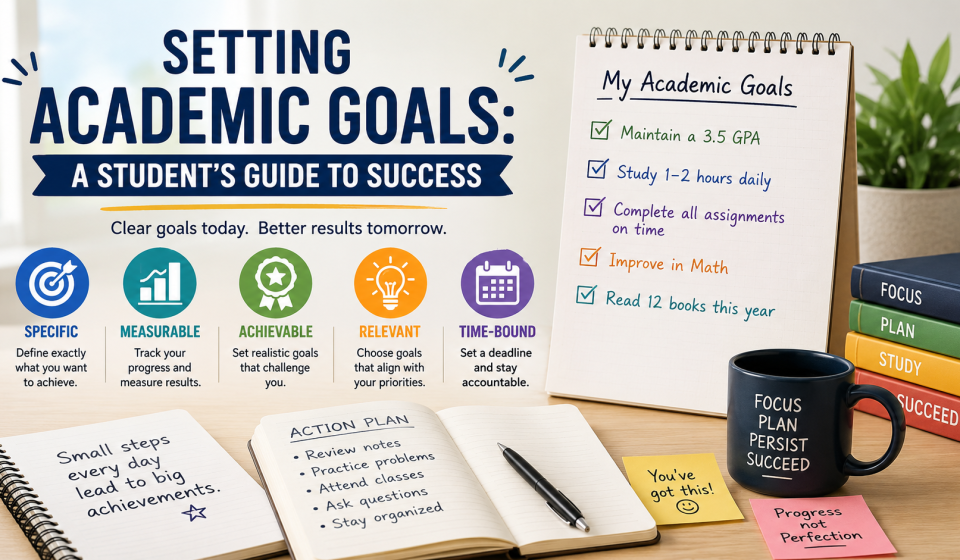

Learn how to set academic goals effectively with this student-friendly guide. Discover practical tips, real-life examples, benefits, and strategies to achieve academic success and build a brighter future.
Every student dreams of doing well in studies, securing good marks, and building a successful career. However, dreams alone are not enough. Success in academics often starts with one important step: setting clear academic goals.
Think about it. If you’re travelling from Ahmedabad to Delhi, you need to know your destination before choosing the route. Similarly, students need clear goals to know where they are heading in their educational journey.
Whether you’re in school, college, or preparing for competitive exams, academic goals can help you stay focused, motivated, and organized.
What Are Academic Goals?
Academic goals are specific targets that students set for their education. These goals can be short-term or long-term.
Short-Term Goals
- Scoring above 80% in the next exam.
- Completing homework on time.
- Improving performance in Mathematics.
- Reading one educational book every month.
Long-Term Goals
- Securing admission to a top college.
- Cracking competitive exams like JEE, NEET, UPSC, or CAT.
- Achieving a specific CGPA in college.
- Building skills required for a dream career.
Having clear goals gives students a sense of direction and purpose.
Why Are Academic Goals Important?
1. Improve Focus
Students often get distracted by social media, gaming, or other activities. Goals help them stay focused on what truly matters.
For example, a Class 12 student preparing for board exams is more likely to avoid distractions when aiming for a 90% score.
2. Increase Motivation
Goals provide a reason to work hard every day. Seeing progress toward a target creates confidence and enthusiasm.
3. Better Time Management
Students who have clear goals can prioritize tasks effectively. They know which subjects require more attention and how to allocate study time.
4. Reduce Stress
A planned approach prevents last-minute panic. Instead of worrying before exams, students can follow a structured preparation strategy.
5. Build Self-Discipline
Consistently working toward goals helps students develop habits that benefit them throughout life.
How to Set Effective Academic Goals
Make Goals Specific
Instead of saying:
“I want to improve my studies.”
Say:
“I want to score 85% or above in my final exams.”
Specific goals are easier to track and achieve.
Keep Goals Realistic
Setting impossible goals can lead to frustration.
For example, a student currently scoring 50% may first aim for 65% or 70% rather than expecting 95% immediately.
Set a Timeline
Every goal should have a deadline.
Examples:
- Complete Science syllabus by December.
- Finish revision one month before exams.
- Solve 20 mathematics problems daily.
Break Big Goals into Smaller Steps
Large goals can feel overwhelming.
For instance:
Goal: Score 90% in board exams.
Steps:
- Study 3 hours daily.
- Complete weekly revision.
- Take one mock test every weekend.
- Focus on weak subjects.
Small achievements build confidence and make the larger goal achievable.
Track Your Progress
Regularly review your performance.
You can use:
- Study planners
- Mobile apps
- Journals
- Weekly progress charts
Monitoring progress helps identify areas that need improvement.
Real-Life Example: Riya’s Journey to Better Grades
Riya, a student from Vadodara, struggled with Mathematics and often scored below 60%.
Instead of feeling discouraged, she set a clear goal: score at least 80% in Mathematics within one academic year.
She created a study schedule, practiced daily, attended extra classes, and solved previous years’ question papers.
Gradually, her confidence improved. By the end of the year, she scored 83%.
The difference wasn’t intelligence—it was goal-setting and consistent effort.
Common Mistakes Students Make While Setting Goals
Setting Too Many Goals
Trying to improve everything at once can be overwhelming.
Focus on a few important goals first.
Comparing Yourself with Others
Every student learns differently.
Instead of comparing marks with friends, focus on your own improvement.
Ignoring Weak Subjects
Many students spend more time on subjects they already enjoy.
Balanced preparation is important for overall success.
Giving Up Too Early
Progress takes time. Temporary setbacks do not mean failure.
Stay consistent and keep moving forward.
Tips for Parents to Support Academic Goals
Parents play a crucial role in a student’s success.
Here are some ways they can help:
- Encourage realistic goal-setting.
- Create a positive study environment.
- Appreciate effort, not just results.
- Avoid unnecessary pressure.
- Celebrate small achievements.
Supportive families often help students stay motivated and confident.
Technology Can Help
Modern students have access to many useful learning tools.
Examples include:
- Online learning platforms
- Educational YouTube channels
- Digital planners
- Mock test websites
- Study reminder apps
When used wisely, technology can significantly improve academic performance.
Balancing Academic Goals with Well-Being
Academic success should not come at the cost of physical or mental health.
Students should:
- Sleep 7–8 hours daily.
- Exercise regularly.
- Take study breaks.
- Eat healthy meals.
- Spend time with family and friends.
A healthy mind learns better and performs more effectively.
Sources
https://l1nq.com/b0oy53d
https://sl1nk.com/7h34de1
Conclusion
Setting academic goals is one of the most effective ways for students to achieve success. Clear goals provide direction, improve focus, boost motivation, and help students manage their time wisely.
Remember, success is not about being perfect. It is about making steady progress every day. Whether your goal is improving grades, mastering a difficult subject, or getting into your dream college, the key lies in planning, consistency, and determination.
Start small, stay committed, and keep moving forward. Every great achievement begins with a well-defined goal.
FAQs
1. What are academic goals?
Academic goals are specific educational targets that students set to improve their learning, grades, skills, or career opportunities.
2. Why is goal-setting important for students?
Goal-setting helps students stay focused, motivated, organized, and better prepared for academic challenges.
3. How can students create realistic academic goals?
Students should assess their current performance, identify areas for improvement, and set achievable targets with clear deadlines.
4. How often should academic goals be reviewed?
Students should review their goals weekly or monthly to track progress and make necessary adjustments.
5. Can academic goals help reduce exam stress?
Yes. Proper planning and goal-setting reduce last-minute preparation pressure and improve confidence before exams.