
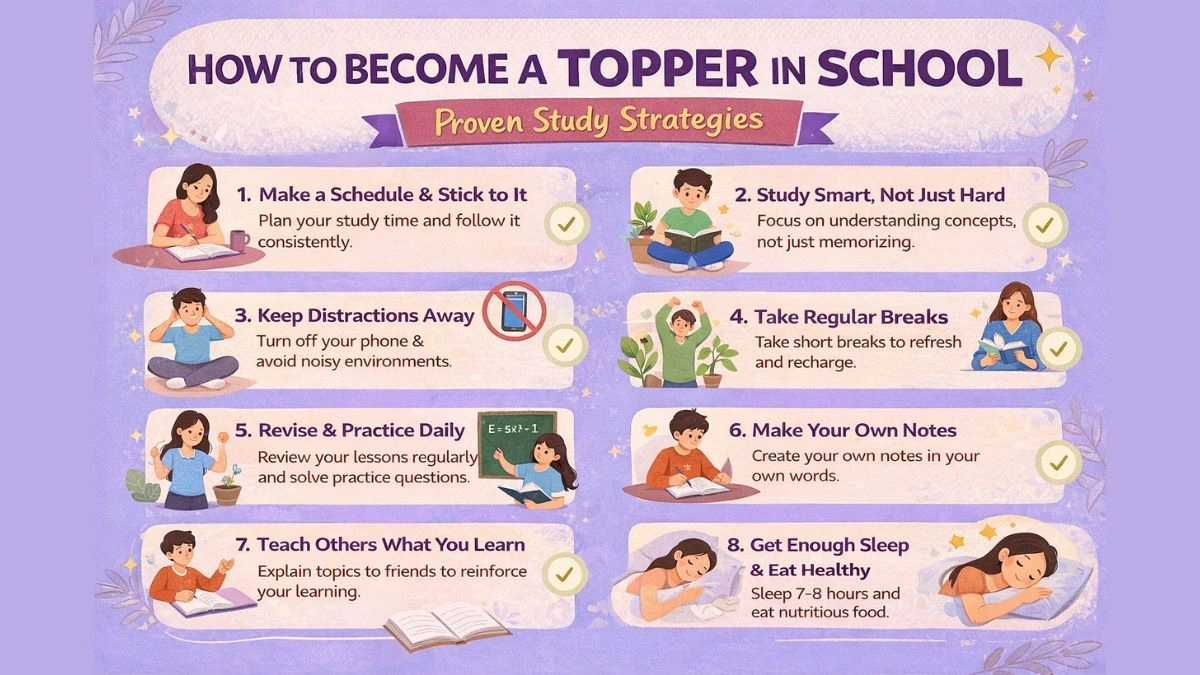
Every student dreams of becoming a school topper, but it’s not just about studying hard—it’s about studying smart. In 2026, with the increasing competition and updated exam patterns, students need effective strategies to consistently score high marks and stay ahead.
This guide provides proven study strategies, tips, and daily routines to help students become top performers in school.
Why Smart Study Strategies Matter
Many students spend hours studying but see little improvement. The key difference between average students and toppers is how they study, not how long. Smart strategies help students:
- Retain information effectively
- Improve time management and productivity
- Reduce exam stress and anxiety
- Consistently perform well across all subjects
Proven Study Strategies to Become a Topper
Here are the most effective strategies used by toppers to achieve excellent results.
1. Create a Structured Study Schedule
A well-planned daily routine ensures all subjects are covered without stress.
Tips for an effective schedule:
- Allocate more time to weak subjects
- Include daily revision sessions
- Plan short breaks every 45–50 minutes
- Stick to the schedule consistently
Example:
- Morning: Maths and Science (focus on difficult topics)
- Afternoon: Languages and Social Studies
- Evening: Homework and revision
2. Focus on Understanding Concepts
Toppers focus on understanding concepts rather than rote memorization.
Tips:
- Use diagrams, flowcharts, and real-life examples
- Ask “why” and “how” to deepen understanding
- Teach concepts to others to reinforce knowledge
Example:
- In Physics, understand the principle behind each formula instead of just memorizing it.
3. Take Effective Notes
Notes are essential for quick revision and memory retention.
Tips:
- Use bullet points, headings, and highlight keywords
- Summarize each chapter in one page
- Maintain separate notebooks for each subject
Why it works: Toppers revise from concise, well-organized notes instead of heavy textbooks.
4. Practice Regularly
Practice is crucial, especially for Maths, Science, and problem-solving subjects.
Tips:
- Solve sample papers and previous year questions
- Time your practice to improve speed
- Analyze mistakes and focus on weak areas
Example:
- Solve 2–3 previous Maths papers weekly and note common errors.
5. Revise Consistently
Revision is the secret behind toppers’ success.
Tips:
- Daily review of what was studied in school
- Weekly review of the entire syllabus covered
- Use flashcards for formulas, dates, and key points
Why it works: Regular revision ensures long-term retention.
6. Use Active Recall and Spaced Repetition
Active recall means testing yourself rather than just rereading notes.
Spaced repetition involves revisiting topics at intervals.
Example:
- Learn a chapter in Science
- Recall key points without looking
- Review again after 2–3 days, then a week later
These methods strengthen memory and exam readiness.
7. Stay Organized
Organization helps toppers avoid wasting time.
Tips:
- Keep a clean study desk
- Arrange books, stationery, and notes neatly
- Use a planner to track assignments, tests, and deadlines
Why it works: An organized study space improves focus and efficiency.
8. Solve Sample Papers and Mock Tests
Toppers practice under exam conditions to improve performance.
Tips:
- Solve past 5–10 years’ question papers
- Take timed mock tests for each subject
- Analyze performance and work on weak areas
Why it works: Familiarity with the exam pattern reduces anxiety and improves accuracy.
9. Take Care of Health
Good physical and mental health is crucial for peak performance.
Tips:
- Sleep 7–8 hours daily
- Eat balanced meals with fruits, vegetables, and proteins
- Take short breaks to relax your mind
- Exercise or practice yoga to reduce stress
Healthy students concentrate better and retain more information.
10. Stay Motivated and Positive
Top students maintain a positive mindset and self-confidence.
Tips:
- Set short-term goals and reward achievements
- Avoid negative self-talk
- Surround yourself with supportive friends and family
- Visualize success to stay motivated
Example:
- Set a goal to complete a chapter and reward yourself with a hobby or small treat.
Daily Routine of a School Topper (Sample)
| Time | Activity |
|---|---|
| 6:00 AM – 6:30 AM | Wake up, freshen up, light exercise |
| 6:30 AM – 7:00 AM | Breakfast |
| 7:00 AM – 8:00 AM | Study difficult subjects (Maths/Science) |
| 8:30 AM – 3:30 PM | School hours |
| 4:00 PM – 5:00 PM | Homework & assignments |
| 5:00 PM – 6:30 PM | Practice and revision (languages/socials) |
| 6:30 PM – 7:00 PM | Break / Snack |
| 7:00 PM – 8:30 PM | Active recall, sample papers, problem-solving |
| 8:30 PM – 9:00 PM | Revision of key points |
| 9:00 PM – 9:30 PM | Prepare for bed, relax |
| 9:30 PM – 10:00 PM | Sleep |
Additional Tips for Becoming a Topper
- Group study wisely: Discuss doubts but avoid distractions
- Use digital tools: Apps like Quizlet, BYJU’S, or Khan Academy
- Stay consistent: Daily small progress beats last-minute cramming
- Practice writing answers: Improves speed and clarity during exams
- Track progress: Maintain a performance diary
Also Read : https://www.21kschool.com/in/blog/study-routine/
Conclusion
Becoming a school topper in 2026 is achievable with the right study strategies, discipline, and mindset. By creating a structured routine, understanding concepts, revising consistently, practicing regularly, and maintaining health, students can maximize their potential and achieve top ranks.
Remember, success comes from studying smart, staying consistent, and believing in yourself. Start implementing these strategies today, and you’ll notice steady improvement in your marks and confidence.
FAQs – How to Become a School Topper
1. Can anyone become a topper?
Yes, with consistent effort, smart study strategies, and time management, any student can achieve top ranks.
2. How much time should I study daily to become a topper?
- 3–5 focused hours outside school, along with daily revision, is sufficient.
3. Is memorization enough to become a topper?
No. Understanding concepts, practicing, and revising regularly is more effective than rote memorization.
4. How can I avoid stress while aiming to be a topper?
- Take breaks, maintain hobbies, exercise, and ensure proper sleep.
5. How early should I start preparing for exams?
Start revision at least 2–3 months before exams and practice regularly to avoid last-minute pressure.